Carolina Commons

Built for
what's next.

Most people stopped believing their input matters. Carolina Commons is built for what comes after that disillusionment: a structured path from community conversation to collective direction, powered by AI tools that help us see further and decide better together.

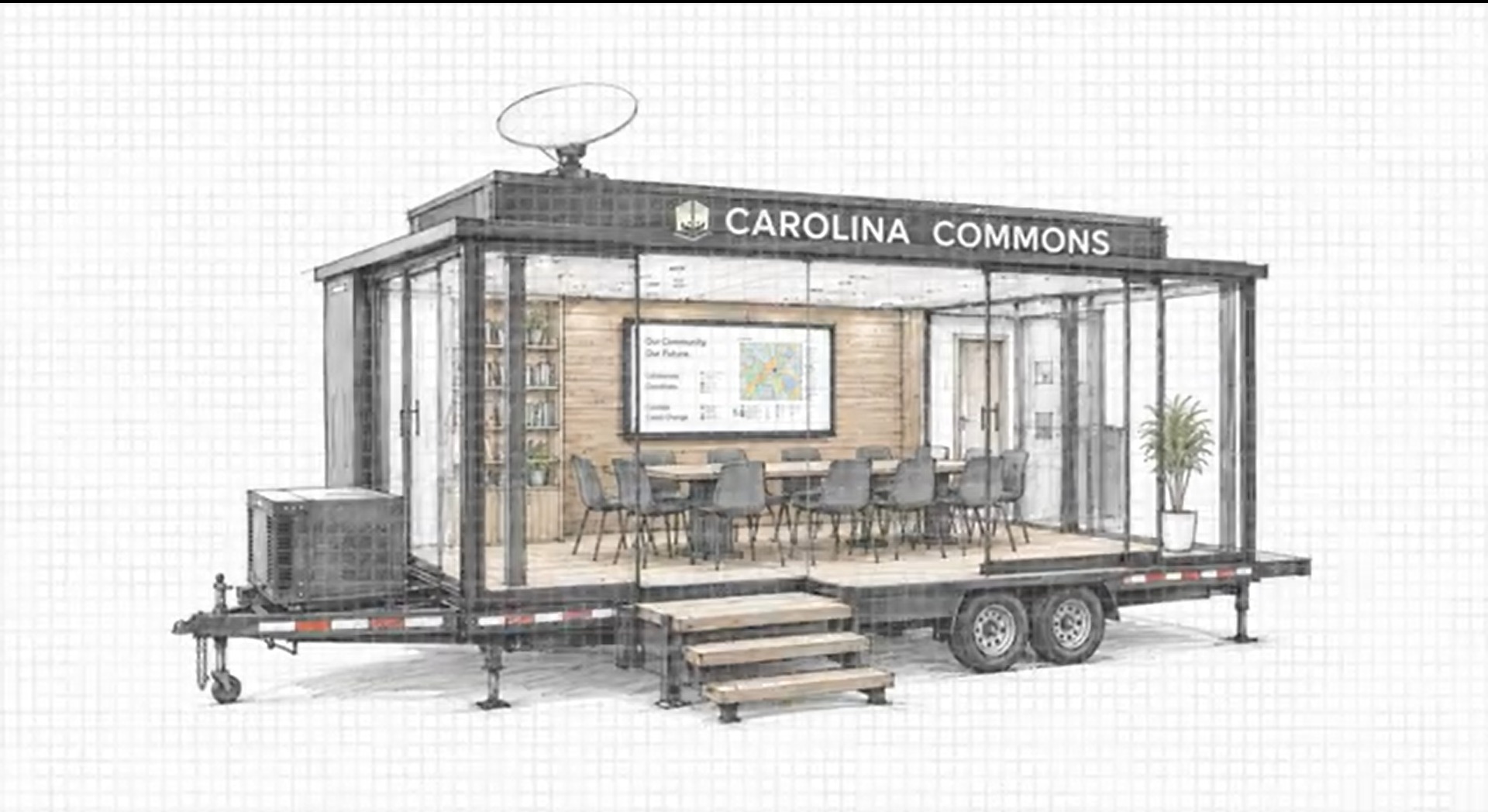
The Commons Table — mobile glass-walled conference room
Coming soon · Crowdfunding
The Commons Table

Most civic conversations happen behind closed doors, in rooms most people will never enter. The Commons Table changes that. A mobile glass-walled conference room that rolls into neighborhoods — visible to everyone on the street, accountable to everyone watching. When the conversation about your community happens in your community, something shifts. That's the design.

Help build the room · Campaign launching soon
Active deliberation · Join now
Education Futures:
What We Need from the Next Ten Years

Three community conversations across three communities. 80+ residents at 11 tables — covering Pre-K through higher education, across three developmental stages — arriving at outcomes that converge in striking ways.

  • Feb 20 · Durham — 20 participants, 3 tables
  • Apr 9 · Chapel Hill — 36 participants, 5 tables
  • May 20 · Raleigh — 3 tables, diverse perspectives
  • Public deliberation open — Join via Pol.is now
Join the conversation →
See it in action
What Carolina Commons looks like when it's working

Strangers across every kind of difference, finding what they actually agree on. Collective intelligence — in the room, not in a server.

Seed Statement Charter Every public deliberation on this platform is governed by a published charter explaining how framing statements were written, who reviewed them, and how you can challenge them.
Read the Charter →
What is Carolina Commons

Your voice,
built to last.

Communities don't lack opinions. They lack infrastructure. The infrastructure to collect what people will support, test it against real-world constraints, and hand elected officials something they can act on — something too clear and too broadly held to ignore. That infrastructure exists now. This is it.

Structured deliberation

Real conversations, designed to produce real outcomes. A structured process that surfaces what a community will support and turns it into direction.

Shared sightlines

Decisions look different when everyone is working from the same picture. We integrate ecological, social, and economic data so communities can see the real shape of their choices before they make them.

Collaborative AI

AI that works for the room, not the algorithm. It synthesizes complexity, surfaces what matters, and keeps elected officials accountable to what the community actually said.

A clear path forward

Community direction without a path to action is just a report. We identify the legislation, programs, and public funding streams already positioned to make community priorities real — so elected officials arrive at a solution, not just a problem.

"The future of a place is shaped by whoever shows up to decide it. Carolina Commons makes sure that's everyone."
Carolina Commons
How it works

From conversation
to collective action

1

Deliberate

Structured conversations — in person and online — that actually go somewhere. The Commons Table brings the room to the neighborhood. Pol.is brings the neighborhood to the conversation. Together they surface what a community will support, at a scale that can't be dismissed.

2

Stress-test the direction

Good intentions have killed plenty of good ideas. Before a community direction becomes a mandate, we run it against ecological, economic, and social reality — so what emerges is something that can actually be sustained, not just agreed upon.

3

Map what already exists

The path forward is almost never built from scratch. We identify the legislation, programs, and public funding streams already positioned to act on what the community has named. The work may already be funded. It just needs direction.

4

Hand elected officials something they can act on

Not a petition. Not a report. A community-backed direction, stress-tested and sourced, that arrives with a clear path to enactment. Too broadly held to ignore. Too well-supported to shelve.

What we're committed to

  • Communities don't lack answers. They lack the infrastructure to act on them together. That's what we're building.
  • Democracy works when it's a real conversation across real differences — not a majority overriding a minority, but a community finding what it will support together.
  • Polarization shrinks when people have more choices and more ways to participate. Technology can open that space rather than close it.
  • AI earns its place when it serves the room — synthesizing complexity, surfacing options, and keeping human judgment at the center.
  • Transparency isn't a feature. Every assumption, every method, every framing choice is open to examination — because trust has to be built, not assumed.
  • The decisions shaping your community are being made right now. Carolina Commons exists to make sure your voice is in the room when they are.
  • Technology concentrates power when we let it. Carolina Commons is built to do the opposite — open-source governance, community-owned data, rotating citizen leadership. Designed to give power away, and to work without us if it needs to.
How online deliberation surfaces agreement and disagreement
Seed Statement Charter

How every deliberation
is transparently framed

Whoever writes the seed statements shapes the opinion space before the first citizen arrives. This charter exists because transparency about framing is a democratic act — and Carolina Commons holds itself to the same standard it asks of everyone else.

VersionEducation Futures · 2026
LicenseCC BY-SA 4.0 — copy, adapt, credit
Part I · Why this document exists
Article 1The framing problem

Online deliberation platforms like Pol.is cluster participant votes into opinion groups. But the statements participants vote on are not neutral — they reflect choices made by the people who wrote them. Seed statements are editorial decisions. This charter names that explicitly, and makes our editorial process visible and contestable.

Plurality note Audrey Tang and co-authors warn that civic tech deployments risk becoming new asymmetries of interpretive authority. This charter is our direct response to that critique.
Article 2The Carolina Commons commitment

Carolina Commons is built on the principle that intelligence must serve wisdom, not substitute for it. AI tools — including Pol.is — assist community deliberation. They do not replace the judgment of participants. This means we must be especially careful about what enters the system before participants do.

Part II · How seed statements are written
Article 3Community authorship first

Seed statements are drawn primarily from in-person session transcripts — the actual words participants used at the table. For the Education Futures series, three sessions across Durham, Chapel Hill, and Raleigh produced the raw material. Statements are extracted, not invented.

Article 4Facilitation team review

Extracted statements are reviewed for clarity, votability, and balance — including tensions and minority positions, not only majority throughlines. No statement is edited to favor a particular outcome. Where possible, review includes a community member not on the facilitation team.

Article 5What we do not do

The facilitation team does not use AI to generate seed statements from scratch. We do not write statements that were not surfaced in community sessions. We do not exclude a viewpoint because it is uncomfortable or inconvenient. Omission is also a framing choice — and we name it here as one we refuse to make silently.

Part III · How the framing can be challenged
Article 6Open statement submission

Pol.is participants may submit new statements at any time. The facilitation team approves those that are on-topic and votable — regardless of whether they challenge existing framing. Approval is the default. Rejection requires written justification, published here.

Article 7Framing challenge process

Any participant who believes the seed statements systematically excluded a perspective may email michael@coherence-lab.com with subject line "Seed Statement Challenge." Challenges are reviewed within 5 business days. If we agree framing was incomplete, new statements are added and this document is amended. If we disagree, our reasoning is published here.

Article 8Session source material

Video recordings and facilitation notes from in-person sessions are available at education-futures-outcomes.netlify.app. Participants can trace any seed statement back to the session where it originated. The conversation canvas is one layer of the record — not its beginning.

Part IV · What this charter does not claim
Article 9Acknowledged limitations

This charter does not make the seed statement process perfectly neutral — no such process exists. In-person sessions reflect who chose to attend, what facilitators noticed, and how conversation was structured. We surface these limitations rather than hide them. The goal of the Commons is transparent stewardship of perspective, not its elimination.

From the project philosophy Transparency is not a feature — it is a foundation. Without trust, there is no Carolina Commons.
Article 10Forkability

This charter is licensed CC BY-SA 4.0. Any community running a deliberation process is free to copy, adapt, and publish their own version — provided they credit the source and share alike. The Commons spreads by being adopted and adapted, not sold or franchised.
Stay involved

The future is co-created
by those who show up.

Three sessions. Eighty voices. Eleven tables across Durham, Chapel Hill, and Raleigh — and a public deliberation now open to everyone. Add your voice to the Education Futures conversation, follow Carolina Commons as it grows, or reach out if you want to bring this infrastructure to your community.

Join the online deliberation See Education Futures → Read the Charter →